
Water Heater Repair
Get a free quote for water heater repair from your local plumbing team.
We’ll contact you about your water heater repair request. Privacy policy
Hear from Our Customers
When your water heater stops working, everything stops with it morning showers, school routines, the basic rhythm of a functioning household. For a Galt family catching the Highway 99 Express at 5:20 a.m., that’s not just inconvenient. It’s a real problem that needs a real solution today, not sometime next week.
Galt runs entirely on groundwater pulled from the Cosumnes Subbasin. Even after the city treats it for iron, manganese, and arsenic, that water still carries more mineral content than what flows through surface-water communities to the north. Over time, those minerals settle at the bottom of your tank as sediment. That sediment makes your heating element work harder, burns more energy, and quietly accelerates the kind of internal corrosion that shortens your unit’s life. The popping or rumbling sound your water heater makes? That’s not normal aging that’s a symptom with a cause.
Getting a technician who understands what Galt’s water supply actually does to a water heater changes the quality of the repair. It means diagnosing the right problem, not just the obvious one. It means your repair holds, your system runs efficiently, and you’re not calling again in six months for the same issue.
We’ve built our reputation on one thing most plumbing companies can’t seem to manage: doing exactly what we said we’d do, for exactly what we said it would cost. Our customers have noted that the final invoice sometimes comes in below the original estimate. In a market where surprise charges are practically expected, that track record means something.
We serve homeowners across Sacramento County’s southernmost communities, including Galt, and we know this area. We know that older homes near Old Town Galt often have legacy plumbing that requires a more careful diagnostic approach. We know that Galt’s groundwater conditions create wear patterns that a technician unfamiliar with the area might misread entirely.
Our 4.7/5 Google rating across 93 verified reviews isn’t built on one standout job it reflects consistent performance from a team that shows up on time, explains the work clearly, and respects your home. That’s the standard on every call, whether it’s a routine repair or a 2 a.m. emergency.
When you call us, the first thing that happens is a real conversation not a hold queue or a callback window measured in days. We ask the right questions up front: what symptoms you’re seeing, how old the unit is, whether it’s gas or electric, and when the problem started. That information lets us arrive prepared instead of diagnosing blind.
Once on-site, we run a thorough assessment before touching anything. In Galt, that means checking for sediment accumulation at the tank base, evaluating the anode rod condition which depletes faster in high-mineral groundwater inspecting the pressure relief valve, and testing heating elements or the pilot assembly depending on your unit type. We tell you exactly what we found and what it means before we quote the repair.
If a replacement makes more financial sense than a repair, we’ll say so with numbers, not pressure. Every water heater installation in California requires a permit, and we handle that process for you. That includes the required seismic strapping under California code, which protects your home in the event of an earthquake and is something unlicensed or out-of-state operators frequently skip. When the work is done, it’s inspected, documented, and done right.
Ready to get started?
We handle the full range of water heater repair and replacement needs for Galt homeowners tank and tankless systems, gas and electric units, standard repairs and full installations. Whether your thermostat has failed, your heating element is burned out, your pilot light won’t stay lit, or your tank is leaking from the base, we’ve seen it and we know how to fix it.
For Galt homes specifically, we pay close attention to the issues that Cosumnes Subbasin groundwater tends to create: heavy sediment buildup, accelerated anode rod depletion, and discolored hot water caused by iron or manganese interacting with an aging tank interior. These aren’t random failures they’re predictable patterns in this water environment, and catching them early saves you from a much larger repair bill or a flooded utility room. A water heater failure that goes unaddressed can result in water damage averaging $1,300 to $5,550 in restoration costs alone.
We also work with homeowners in Galt who are ready to upgrade. Tankless water heaters are a strong fit for this area they eliminate the sediment-accumulation problem entirely since there’s no storage tank, they last 20-plus years compared to 8 to 12 for traditional tank units, and they can qualify for federal energy efficiency tax credits. If you’re weighing repair against replacement, we’ll give you an honest breakdown of both options so you can make the call that makes sense for your household and your budget.
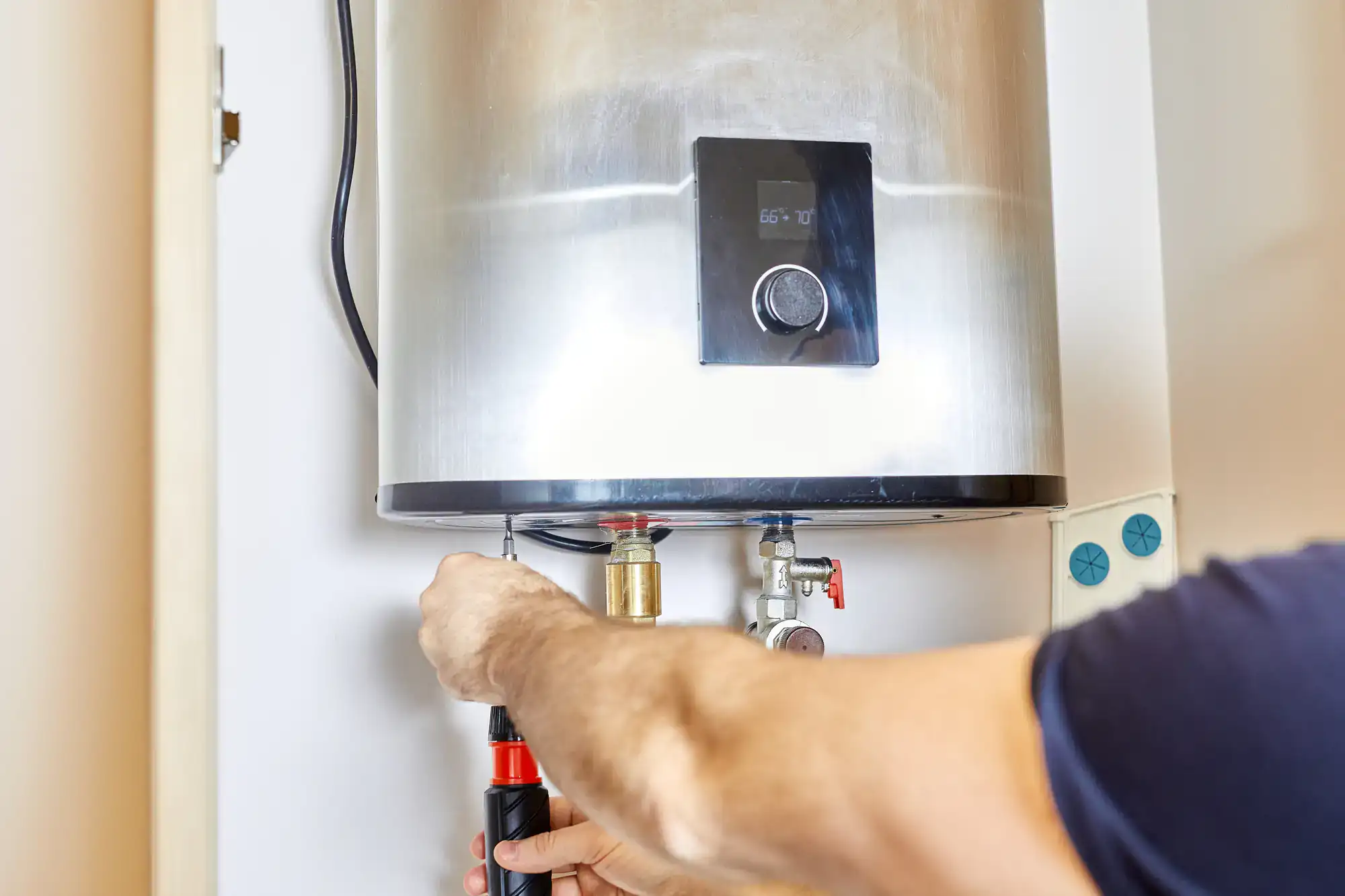
That popping or rumbling sound is almost always sediment. Galt’s municipal water supply comes entirely from groundwater specifically the Cosumnes Subbasin and even after the city treats it for iron and manganese, that water carries more dissolved minerals than surface-water supplies. Over time, those minerals settle at the bottom of your tank as a hardened layer of sediment.
When your heating element fires, it has to push heat through that sediment layer to warm the water above it. The popping sound is water trapped beneath or within the sediment boiling and forcing its way through. Beyond the noise, this process forces your unit to run longer and work harder to reach your set temperature, which drives up your energy bill and accelerates wear on the heating element itself.
A tank flush can address early-stage sediment buildup, but if the accumulation is significant, it may indicate that the tank has been operating this way for years. In that case, a full diagnostic will tell you whether a flush and element inspection is the right move or whether the unit is approaching the end of its useful life. Either way, ignoring the noise is not a cost-free choice.
The cost of water heater repair in Galt depends entirely on what’s actually wrong with the unit. Common repairs like replacing a thermostat, swapping out a heating element, or relighting and servicing a pilot assembly typically fall in the $100 to $350 range. More involved repairs, such as replacing a pressure relief valve, addressing a significant leak, or servicing a tankless unit’s heat exchanger, can run higher depending on parts and labor.
If a full replacement is the right call, you’re generally looking at $1,600 to $5,500 installed for a new unit, depending on the type and capacity. Tankless systems sit at the higher end of that range, but they also last significantly longer and carry energy efficiency advantages that matter in a household running on Galt’s mineral-heavy groundwater.
At Murray Plumbing, you get a clear, upfront quote before any work begins. No estimates that balloon at the invoice stage, no upsell pressure. If the final cost comes in below what we quoted which has happened that’s what you pay. Galt homeowners deserve to know what they’re committing to before they say yes.
Yes California law requires a permit for every water heater installation or replacement, and that requirement applies in Galt. The permit triggers a required inspection, which ensures the work meets the California Plumbing Code. This matters more than most homeowners realize: unpermitted plumbing work can become a serious liability when you go to sell your home, and it can also affect your homeowner’s insurance coverage if something goes wrong.
In addition to the permit itself, California requires that all water heaters be secured with seismic strapping earthquake restraints that prevent the unit from tipping and rupturing a gas line or causing a flood during seismic activity. This is a California-specific code requirement that out-of-state operators or unlicensed contractors may not know or follow.
We handle the permit process as part of every water heater replacement in Galt. You don’t have to navigate the City of Galt’s building department or Sacramento County requirements on your own we take care of it, and the work gets inspected and properly documented. That’s what code-compliant installation looks like, and it’s the standard we hold ourselves to on every job.
The general rule is this: if your water heater is under eight years old and the repair cost is less than half the price of a new unit, repair usually makes financial sense. If the unit is ten years or older, or if the repair cost is significant relative to replacement, a new unit often gives you better long-term value especially in Galt, where groundwater mineral content tends to accelerate internal wear.
There are a few signs that lean strongly toward replacement regardless of age: a tank that’s actively leaking from the base, rust-colored hot water that persists after flushing (which suggests internal tank corrosion), or a unit that has required multiple repairs in a short window. These are indicators that the tank’s structural integrity is compromised, and additional repairs are likely to be short-lived.
When you call us, we run a full diagnostic before recommending anything. We’ll tell you exactly what we found, what it would cost to repair, what a replacement would cost, and what we’d do if it were our own home. There’s no pressure toward the more expensive option just an honest breakdown so you can make the decision that fits your situation and your budget.
A standard tank water heater typically lasts 8 to 12 years under normal conditions. In Galt, where the municipal supply comes from Cosumnes Subbasin groundwater with naturally elevated mineral content, units that haven’t been maintained specifically, tanks that have never been flushed and anode rods that have never been replaced can start showing significant wear closer to the 7 to 9 year mark.
The anode rod is the component most affected by Galt’s water chemistry. It’s a sacrificial metal rod inside the tank designed to corrode in place of the tank walls. In high-mineral water, it depletes faster than in softer surface-water environments. Most homeowners have never heard of it, let alone replaced it but a depleted anode rod means the tank itself starts corroding from the inside out, and that’s the beginning of the end for most units.
Regular maintenance an annual flush to clear sediment and an anode rod inspection every three to four years can meaningfully extend your water heater’s lifespan in Galt’s water environment. Tankless systems sidestep the sediment issue entirely and routinely last 20-plus years, which is one reason they’re worth considering for Galt homeowners who are already facing a repair on an aging tank unit.
Yes. We offer 24/7 emergency water heater repair in Galt, CA. That means if your water heater fails at 11 p.m. on a Tuesday or early on a Saturday morning, you have a licensed technician available not a voicemail box and a callback window that stretches into the next business day.
This matters in Galt specifically because of how the community is structured. A significant portion of Galt households are commuter families catching early Highway 99 departures into Sacramento or Elk Grove. A water heater that fails overnight doesn’t get discovered until 5 a.m., and by then there’s no margin to wait. Emergency availability isn’t a premium add-on here it’s a basic service reality for how Galt families actually live.
It also matters financially. A water heater that’s actively leaking and left unaddressed overnight can cause water damage that runs $1,300 to $5,550 in restoration costs a bill that dwarfs the cost of an emergency service call by a significant margin. Calling immediately when something goes wrong is almost always the less expensive decision, and we’re available to respond when it counts.