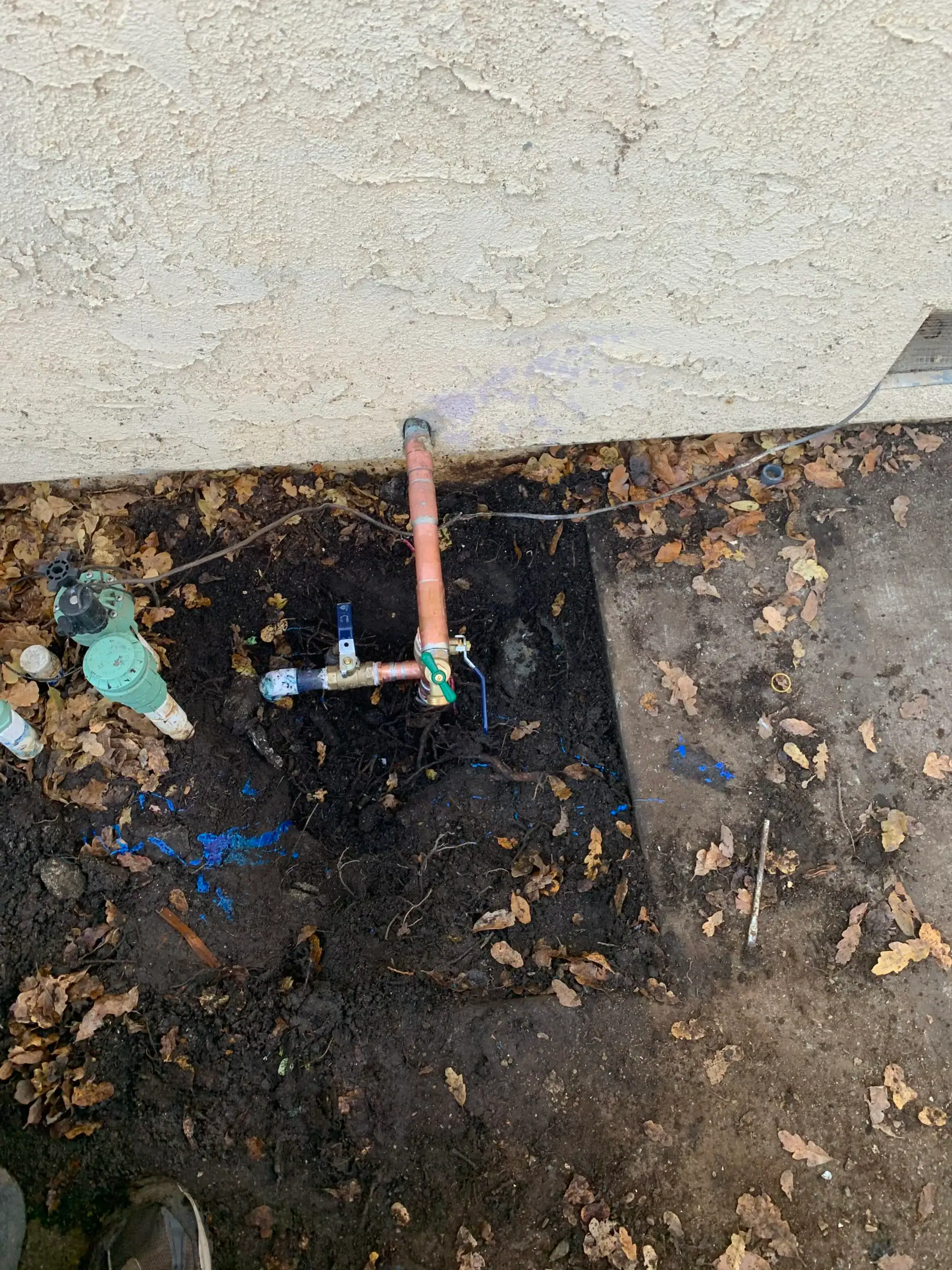
Your water pressure tells you more about your plumbing than almost anything else. Here's what the numbers actually mean for homes across the Sierra foothills and Sacramento region.
Share:
Summary:
Most people don’t think about water pressure until something feels off. The shower that used to feel strong now trickles. The sink loses pressure the moment the dishwasher kicks on. Or there’s a banging sound in the walls every time you turn off a faucet — and you have no idea what it means.
Here’s the thing: water pressure is one of the most telling indicators of what’s actually happening inside your plumbing. One reading can tell you whether you have a simple fix or a bigger problem developing. This post walks you through what normal looks like, what the California Plumbing Code requires, and why homes in El Dorado County, Placer County, and the Sacramento region face some specific pressure challenges that most generic plumbing guides don’t account for.
The standard range for residential water pressure is 40 to 80 PSI — pounds per square inch. Most plumbers and fixture manufacturers consider 50 to 60 PSI the sweet spot. Below 40 PSI and you’ll start noticing weak flow, especially when multiple fixtures are running at once. Above 80 PSI and you’re putting real stress on your pipes, valves, and appliances every single day.
California’s plumbing code is specific about both ends of that range. CPC Section 304.1 sets the minimum at 20 PSI at the point of delivery under normal conditions. CPC Section 608.1 sets the ceiling at 80 PSI — and requires a pressure-reducing valve, or PRV, to be installed if the incoming supply from the city main exceeds that threshold.
In the Sacramento region and across El Dorado County, municipal mains commonly run at 100 PSI or more, which means a functioning PRV isn’t optional for most homes connected to city water. It’s code-required and practically essential. Homes in Placer County face similar conditions, particularly in communities closer to the valley floor where water pressure from regional distribution systems runs high.

Low pressure gets most of the attention because you feel it immediately — the weak shower, the slow-filling tub. But high pressure is the quieter problem, and in many ways it’s the more destructive one.
When water pressure consistently runs above 80 PSI, it puts constant stress on everything in your plumbing system. Pipe joints that were designed for normal operating pressure start working harder than they should. Fixture seals wear out faster. Water heaters, washing machines, and dishwashers take a beating that shortens their usable life — and most appliance manufacturers will void their warranties if they find the home’s pressure was running above their rated threshold when a failure occurred.
One of the most telling signs of high pressure is water hammer — that banging or thudding sound you hear when you shut off a faucet or the washing machine finishes filling. It’s not just annoying. It’s the physical shock of pressurized water stopping abruptly, and it’s hard on pipe joints every single time it happens.
The tricky part is that a failed PRV often gives you no obvious warning. Your pressure might feel perfectly normal to you — maybe even a little better than usual — while your home is actually running at full main pressure. The PRV is a mechanical device with a typical service life of 10 to 15 years. When it fails, it doesn’t always announce itself. It just stops doing its job.
That’s why pressure that seems “fine” isn’t necessarily fine, especially in homes where the PRV hasn’t been inspected in years. If your home was built in the 1980s or 1990s — which describes a large share of the housing stock in El Dorado Hills, Cameron Park, and older neighborhoods throughout Sacramento County — your original PRV may be well past its reliable service life. Getting it tested costs nothing if you’re already having a plumber out for another reason, and it could save you a significant appliance repair or pipe leak down the road.
If you live in Placerville, Shingle Springs, older parts of Cameron Park, or the foothills communities across El Dorado County and Placer County, there’s a good chance your home was built in the 1970s or 1980s. That means your plumbing system is somewhere between 40 and 50 years old. And if it hasn’t been repiped, there’s a reasonable chance it’s still running on galvanized steel supply lines.
Galvanized pipes don’t fail dramatically. They fail slowly, from the inside out. The zinc coating that was meant to protect the steel erodes over time, and as it does, rust and mineral deposits accumulate on the interior walls of the pipe. The opening gets smaller. Water flow gets restricted. Pressure at your fixtures drops — not all at once, but gradually, over years, until one day you realize your shower hasn’t felt right in a while and you can’t remember when it changed.
El Dorado County’s hard water accelerates this process. The water in this area carries a high concentration of calcium and magnesium, and those minerals deposit inside pipes the same way scale builds up in a kettle. The higher you go in elevation — toward Pollock Pines, Garden Valley, or Georgetown — the longer water has traveled through mineral-rich geology before it reaches your tap, and the more buildup accumulates over time. Sacramento County and Placer County residents at higher elevations experience similar mineral challenges.
This matters for drain cleaning and overall pipe health too, not just supply pressure. Mineral scale doesn’t stay neatly inside supply lines. It affects water heater efficiency, clogs fixture aerators, and contributes to the kind of slow, progressive deterioration that eventually turns into a water leak or a full pipe repair job.
Kitec piping is another material worth knowing about if you own a home in El Dorado, Placer, or Sacramento County. It was commonly used in the late 1990s and early 2000s and is now known to be failure-prone. If your home was built or repiped during that window and you’re seeing pressure problems alongside discolored water or unexplained leaks, Kitec is worth having a plumber check.
The elevation factor in El Dorado County is also something most plumbing guides skip over entirely. The county spans a significant elevation range — from around 1,200 feet in El Dorado Hills to over 4,000 feet in Pollock Pines. Static pressure from a gravity-fed supply system decreases as elevation increases, at roughly 0.43 PSI for every foot of rise. That means a home at higher elevation may have chronically lower baseline pressure that has nothing to do with pipe condition — and may benefit from a booster pump rather than a PRV.
Want live answers?
Connect with a Murray Plumbing expert for fast, friendly support.
Not every pressure issue requires a service call. Some of the most common causes of low pressure at a single fixture are things you can address yourself — a clogged aerator on a faucet, a mineral-blocked showerhead, or a partially closed shutoff valve under the sink. These are worth checking before you call anyone.
The distinction that matters is whether the problem is isolated to one fixture or affecting the whole house. If it’s one faucet, start with the aerator. If it’s your entire home, the cause is somewhere upstream — the PRV, the main shutoff valve, the supply lines, or the pipes themselves. That’s where we come in, because the range of possible causes is wide and the consequences of guessing wrong are real.
One of the reasons homeowners put off calling a plumber is not knowing what they’re walking into financially. Water pressure problems feel like they could be anything from a $30 fix to a multi-thousand-dollar project, and without a number to anchor to, it’s easy to delay.
For most homes in El Dorado County, Placer County, and Sacramento County, a pressure-reducing valve installation runs between $300 and $650, including parts and labor. That’s the range we quote for the majority of homes we work on in Placerville, El Dorado Hills, Cameron Park, and the surrounding communities. It’s not a small expense, but it’s a straightforward one — and it protects appliances, fixtures, and pipe joints that would cost far more to replace if high pressure continues unchecked.
The more expensive scenario is when a PRV failure has been going unnoticed for years and the downstream damage has already accumulated. A water heater that’s been running under excessive pressure for a decade wears out faster. Fixture seals fail more frequently. In some cases, pipe joints develop slow leaks that go undetected until they’ve caused real damage behind a wall or under a floor. Catching a PRV failure early — ideally before it fails completely — is almost always cheaper than dealing with what comes after.
If you’re not sure whether your PRV is functioning correctly, a pressure gauge is the fastest way to get a baseline reading. You can pick one up at any hardware store and attach it to an outdoor hose bib to get your home’s current PSI. If it reads above 80, your PRV either isn’t working or was never installed. If it reads below 40, you’ve got a restriction somewhere in the system. Either way, you now have a number to work with — and a much clearer sense of what you’re actually dealing with.
We offer free estimates, so if your reading raises questions, there’s no cost to have us come out and take a look.
If you’ve noticed your water pressure seems to change at certain times of year, you’re probably not imagining it. In the Sacramento region and across El Dorado County’s foothill communities, seasonal factors genuinely affect plumbing performance in ways that flat-valley homes don’t always experience.
Every summer, the soil in this region dries out and compacts. When fall rains arrive, that dry ground softens and shifts. Underground water lines move with it. Joints that were seated tightly can loosen, developing slow leaks that reduce pressure gradually over the course of the wet season. By the time a homeowner notices the drop, the leak may have been going on for weeks. A water leak that’s been running at even a slow rate can waste thousands of gallons before it’s caught — and it shows up on your water bill before it shows up anywhere visible.
In El Dorado County’s foothill and mountain communities — Pollock Pines, Garden Valley, Camino, Georgetown — freeze-thaw cycles add another layer. Pipes that experience repeated freezing and thawing can develop hairline cracks or shifted joints that slowly affect pressure. This kind of damage often doesn’t announce itself with a dramatic burst. It just creates a slow, quiet pressure drop that gets attributed to something else.
The practical takeaway is that if your pressure has dropped noticeably since fall or winter, it’s worth having your supply lines inspected before you assume it’s a fixture issue or a PRV problem. The cause may be underground and entirely unrelated to anything inside your home. Plumbing maintenance in the fall — before the ground shifts and temperatures drop — is one of the more reliable ways to catch these issues before they become expensive repairs. Homes with hard water or older galvanized pipes benefit from checking in more frequently, given how quickly mineral buildup and corrosion can accelerate when seasonal stress is added on top.
The short version: 50 to 60 PSI is where you want to be. Below 40 and you have a restriction somewhere. Above 80 and your pipes, fixtures, and appliances are working under stress they weren’t designed for — and your PRV may have already failed without telling you.
For homeowners in Placerville, El Dorado Hills, Cameron Park, and the surrounding foothill communities, the most common culprits are aging galvanized pipes, hard water mineral buildup, and PRVs that have quietly passed their reliable service life. These aren’t abstract concerns — they’re documented patterns in the local housing stock across El Dorado County, Placer County, and Sacramento County, and they’re exactly the kind of thing that’s worth catching before they turn into a water leak, a pipe repair, or a failed appliance.
If something feels off with your pressure — or if you’ve never had it checked and your home is more than 20 years old — Murray Plumbing offers free estimates and same-day availability across El Dorado County, Placer County, and Sacramento County. No diagnostic fee, no runaround. Just a straight answer about what’s going on and what it would take to fix it.
Article details:
Share:
Continue learning: