Most water leaks go unnoticed for months. Here is how to spot the signs early, understand the real risks, and know when it is time to call a pro.
Share:
Summary:
Here is something most homeowners do not know: the EPA estimates that 10 percent of homes in the U.S. have leaks wasting 90 gallons or more every single day. Not a slow drip from a faucet you have been meaning to fix; water loss happening right now, somewhere you cannot see it.
If your water bill has crept up without explanation, or you have noticed a faint musty smell you cannot quite locate, this guide is worth your time. We will walk through how hidden leaks work, what to watch for in homes across El Dorado, Placer, and Sacramento counties specifically, and how to stop a small problem before it becomes a very expensive one.
Most water leaks do not start as emergencies. They start as tiny failures: a pinhole in a copper pipe, a hairline crack in a joint, a fitting that has been slowly corroding for years. By the time you find visible damage, the leak has often been active for weeks or months.
What makes this region particularly prone to hidden leaks is not bad luck. It is a combination of aging pipe materials, local water chemistry, and climate conditions that put stress on plumbing systems in ways that are not always obvious until something gives.

If you live in Cameron Park, Shingle Springs, Auburn, or anywhere in the El Dorado County foothills, your home faces leak risks that Sacramento Valley homeowners do not deal with to the same degree.
The foothills average around 40 inches of rain per year, most of it falling between October and March. That seasonal pattern, dry summers followed by heavy wet winters, puts repeated stress on pipes, foundations, and the soil beneath your slab. Clay-heavy soils common in this region expand when wet and contract when dry, and that constant movement is hard on any pipe running beneath a concrete foundation. Slab leaks are a real and recurring issue in El Dorado Hills, Cameron Park, and the older suburban neighborhoods of western Placer County for this reason.
Then there is the freeze factor. Homes above roughly 1,500 feet in elevation, which includes a large portion of El Dorado County from Placerville eastward toward Pollock Pines, experience genuine freeze-thaw cycles every winter. Pipes in uninsulated crawl spaces and outbuildings take the brunt of it. A cold snap in January can stress a pipe that was already showing wear, and the resulting crack may not show up as a visible leak right away. It might just show up as a mysteriously higher water bill in February.
Hard water is another piece of the puzzle. The Sacramento region’s water supply carries mineral content that builds up inside pipes over time, gradually narrowing the interior diameter and increasing pressure on joints and fittings. In older homes with galvanized steel or early copper plumbing, and there are a lot of them across all three counties, this accelerates the timeline toward failure. If your home was built before 1990 and still has its original plumbing, it is worth knowing that those pipes are operating well into the back half of their expected service life.
One more thing worth mentioning for rural El Dorado County homeowners: if your property runs on a private well rather than a city water connection, you lose one of the most useful early-warning tools available: the monthly water bill. Municipal customers often catch hidden leaks when their bill spikes unexpectedly. Well-fed systems do not have that built-in alert, which means leaks can go longer without detection. Properties off Mosquito Road and in the Apple Hill corridor are a good example: larger lots, longer supply line runs, and no utility bill to flag a problem.
The most reliable early warning sign is a water bill that is higher than it should be with no obvious explanation. If your usage has not changed but the number keeps climbing, that is worth investigating before you write it off as a rate increase.
Beyond the bill, pay attention to sounds. Hearing water moving somewhere in your home when every faucet, toilet, and appliance is off is a red flag. It might be faint, a low hiss or a gurgling sound behind a wall, but it is worth stopping to listen for.
Visible signs tend to show up later in the process, once moisture has had time to travel. Soft or discolored spots on drywall, warped or stained flooring, peeling paint near baseboards, and ceiling stains that seem to grow are all indications that water has been present somewhere it should not be. A persistent musty smell, especially in a room that does not have obvious moisture sources, often means mold is already growing inside a wall cavity or under a floor.
There is also a simple test you can do yourself using your water meter. Turn off every water source in the house: faucets, appliances, irrigation, everything. Find your meter and note the reading, then wait 15 to 20 minutes without using any water. If the meter has moved, water is flowing somewhere it should not be. This will not tell you where the leak is, but it will confirm if one exists.
If you are on a private well, this test works a bit differently: you would be listening for the pump cycling on when nothing is drawing water, which is the equivalent signal.
One thing that catches homeowners off guard is the Kitec pipe issue. Homes built between roughly 1995 and 2007 in El Dorado Hills, Roseville, Rocklin, and similar communities may have Kitec flexible plastic pipe, which is known to fail prematurely. If your home falls in that construction window and you have not had the plumbing evaluated, it is worth knowing about.
Want live answers?
Connect with a Murray Plumbing expert for fast, friendly support.
A lot of homeowners assume that finding a hidden leak means tearing open walls and hoping for the best. That is not how it works when the right equipment is involved.
Professional leak detection uses acoustic sensors, electronic detectors, and thermal imaging to pinpoint where water is moving without unnecessary demolition. The goal is to locate the source precisely before any repair work begins, not to guess and cut. That approach protects your home and gives you a clear picture of what you are dealing with before any decisions are made.
When we arrive to investigate a suspected hidden leak, the first job is confirming that a leak exists and narrowing down its location. This is where professional-grade detection equipment earns its keep. Acoustic sensors can detect the sound of water escaping under pressure through a pipe wall, even when that pipe is buried under a concrete slab or hidden inside a wall cavity. Electronic detectors pick up moisture signatures. Thermal imaging can reveal temperature differentials that indicate where water has been traveling.
The reason this matters is not just about avoiding unnecessary demolition, though that is a real benefit. It is about accuracy. A plumber who guesses at a leak location and cuts into the wrong section of wall has not solved your problem; they have added to it. Precise detection means the repair targets the source, not just the nearest access point.
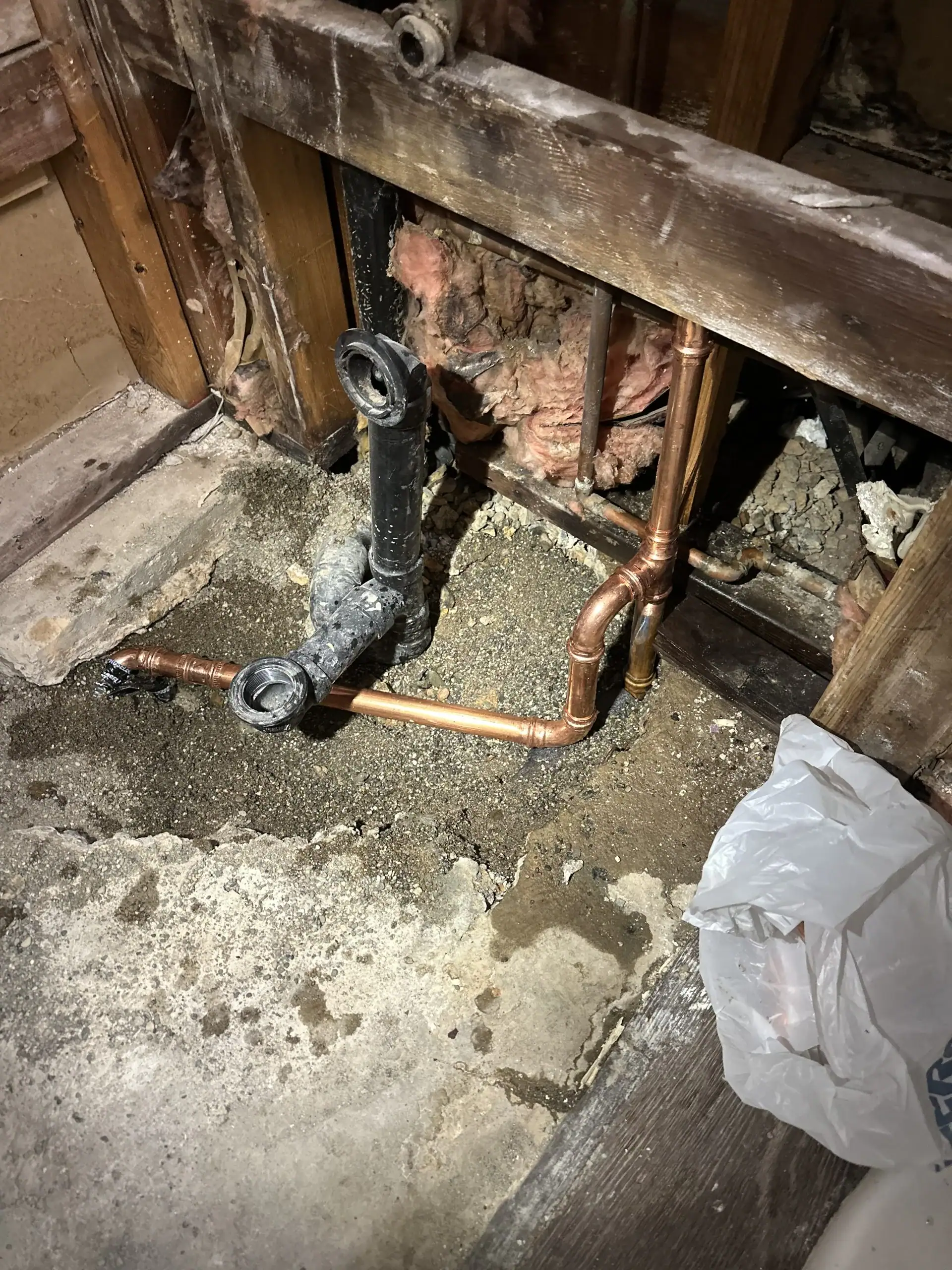
For slab leaks specifically, this process is important. Under-slab pipes that develop leaks can be tricky to locate because water tends to migrate along the path of least resistance before surfacing. What looks like a wet spot near the bathroom might trace back to a leak originating several feet away under the foundation. Without detection equipment, that is nearly impossible to pinpoint without significant exploratory work.
Once the leak is located, a clear repair recommendation can be made. In some cases it is a targeted pipe repair. In others, particularly in older homes where one section of pipe has failed and the rest is in similar condition, a broader repiping conversation makes more sense. The right answer depends on what the inspection finds, not on what is easiest to sell.
It is also worth knowing that for sewer lines and drain systems, waterproof camera inspection provides the same kind of precision. Rather than guessing at what is causing a slow drain or recurring backup, a camera run through the line shows exactly what is there: root intrusion, pipe collapse, buildup, or a joint failure. The diagnosis drives the repair, not the other way around.
Prevention does not require much; mostly awareness and a willingness to act on early signals rather than waiting to see if they go away.
The single most useful habit is checking your water bill month over month. Not just paying it, but looking at the usage numbers. Most utility bills show your current usage alongside the same period from the prior year. If those numbers are drifting apart without a clear reason: a new appliance, a change in household size, a particularly hot summer; that is worth a conversation with us.
For homes in the El Dorado County foothills and higher-elevation Placer County communities, winterizing exposed pipes before the cold season is straightforward and protective. Pipes in uninsulated crawl spaces, garages, and outbuildings are the most vulnerable. Foam pipe insulation is inexpensive and takes an afternoon to install. Disconnecting and draining outdoor hose bibs before the first freeze is another easy step that prevents a common and avoidable burst.
If your home was built between 1960 and 1990, scheduling a plumbing inspection every few years is a reasonable precaution. Not because something is definitely wrong, but because galvanized steel and older copper systems in that age range are operating in territory where failures become more likely. Finding a weak joint before it becomes an active leak is almost always cheaper than addressing the water damage afterward. The EPA estimates that the average household with leaks wastes over 10,000 gallons of water per year, and fixing those leaks typically saves around 10 percent on water bills.
Whole-house leak detector systems are another option worth knowing about. These devices monitor water flow continuously and can alert you, or automatically shut off the water supply, if they detect a flow pattern that suggests a leak. For homeowners who travel frequently or have vacation properties in the Pollock Pines or South Lake Tahoe area, that kind of automated protection is worth considering. We install these systems and can walk you through what makes sense for your specific setup.
For homes on private wells, the equivalent of a water bill check is listening for the pump. If your well pump is cycling on more frequently than usual, or running when no one is drawing water, that is the signal worth investigating. It does not always mean a leak; pressure tank issues can cause similar behavior; but it is the starting point for a diagnosis.
If you have run the water meter test and the needle moved, or you have noticed any of the signs described above, the right call is to have a professional take a look before the situation develops further. A small leak costing a few hundred dollars to fix today can turn into a structural problem, a mold remediation project, or a complicated insurance situation if it is left alone.
You do not need to have it all figured out before you call. You do not need to know if it is a slab leak or a pipe-in-wall leak or something with the supply line. That is what the inspection is for. What matters is not waiting until the damage is visible, because by then the water has usually been there for a while.
Murray Plumbing has been working on homes across El Dorado, Placer, and Sacramento counties for over 24 years: homes with original 1970s plumbing, homes with Kitec pipe, homes on private wells, and everything in between. If something seems off with your water, we are worth a call.
Article details:
Share:
Continue learning: