
Hear from Our Customers
Water damage doesn’t announce itself. It starts as a slow drip behind a wall, a pinhole in a corroded galvanized pipe, or a joint that finally gave out after decades of clay soil shifting under your foundation. By the time you see the stain on the ceiling or smell the mold, the damage is already done and the average insurance claim runs close to $14,000.
A professionally installed water leak detection system changes that equation entirely. Instead of finding out after the fact, you get real-time alerts the moment something is off. If you’re heading up I-80 for a weekend in Tahoe and a water heater line lets go while you’re gone, the system shuts off your main water supply automatically no neighbor with a key, no coming home to a flooded kitchen.
For North Highlands specifically, this matters more than most people realize. Homes built in the 1950s and 1960s near Elkhorn Boulevard and Walerga Road are sitting on clay soil that expands every wet winter and contracts every 100-degree Sacramento summer. That cycle stresses underground pipes at every joint and fitting. Hard water in Sacramento County accelerates corrosion on top of that. A smart leak detection system is the one layer of protection that accounts for all of it and it works around the clock whether you’re home or not.
We’ve been serving North Highlands and Sacramento County homeowners since 2009, and our reputation comes down to one thing: no surprises. The estimate you get before the job is the number you pay at the end and more than a few customers have noted the final bill came in under what was quoted. That’s not an accident. It’s how we operate.
We hold California Contractor’s License #916322 under the C-36 Plumbing classification verifiable at CSLB.ca.gov before you ever pick up the phone. That credential is the legal standard for plumbing work in Sacramento County, and it means every installation we complete meets California Plumbing Code requirements, not just manufacturer specs.
North Highlands is squarely in our service area, and we know what homes here are dealing with. Aging post-war housing stock, Sacramento County permitting through the Building Inspection Division, clay soil that never stops moving these aren’t abstract conditions. They’re what we work around every week. Our 4.7 out of 5 Google rating across 93 reviews reflects that consistency, not a marketing push.
It starts with a call and an honest conversation about your home when it was built, what you know about the plumbing, and whether you’ve had any issues. For a lot of North Highlands homes built before 1975, that conversation usually surfaces something worth knowing before a wrench touches anything. There’s no charge for the estimate, and there’s no pressure to move forward until you’re comfortable with the scope and the number.
Once the job is scheduled, the installation itself covers the full picture. We size the system correctly for your home’s water line diameter this step matters more than most people think, and it’s where DIY installs typically go wrong. The device gets placed after your water meter and pressure regulating valve, which is both the manufacturer requirement and the correct position under Sacramento County plumbing code. A whole-home shutoff system installed in the wrong location doesn’t protect you the way it should.
From there, the Moen Smart Water App gets set up on your phone, alert preferences get configured for your household, and the system gets tested before anyone leaves your driveway. You’ll know how to read the app, how to shut off your water remotely if you need to, and what to do if an alert fires at 2 a.m. on a Tuesday. That walkthrough is part of the job, not an add-on.
Ready to get started?
This is a complete water leak detector installation service, not a drop-in device swap. We handle the Moen smart water leak detection system from start to finish: correct sizing for your water line, proper placement per California Plumbing Code, full connection and pressure testing, Moen Smart Water App setup on your smartphone, and hands-on training so you actually understand what the system is monitoring and how to use it.
For North Highlands homeowners, the automatic shutoff feature is the part that tends to land hardest. If the system detects an abnormal flow pattern the kind that indicates a slow leak inside a wall or under a slab it flags the alert and can close your main water supply line before the damage spreads. Given how many homes in the 95660 ZIP code still have original plumbing running through clay-stressed soil, that layer of protection is not theoretical. It’s the difference between a service call and a full remediation job.
There’s also a real financial case to make here. Smart water leak detection systems can qualify your home for a 5% to 10% discount on your annual homeowners insurance premium, depending on your carrier. Home values in North Highlands have climbed over 107% since 2011 that’s a significant asset worth protecting. The installation cost is a fraction of a single water damage claim, and the insurance savings can offset a meaningful portion of it over time.
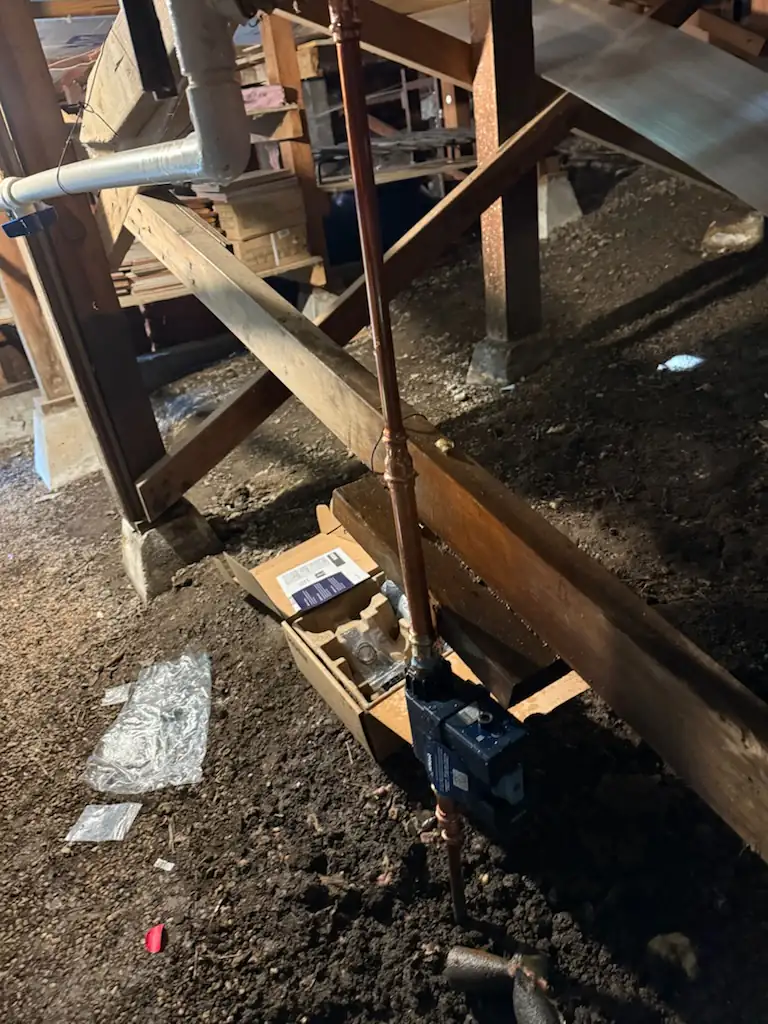
For a simple point-of-use sensor that sits on the floor near your water heater, no license is required you’re just placing a battery-powered device. But a whole-home water leak detection system with an automatic shutoff valve is a different job entirely. That installation involves cutting into your main water supply line, which is plumbing work subject to Sacramento County’s Building Inspection Division and the California Plumbing Code. Any plumbing work exceeding $500 in combined labor and materials legally requires a C-36 licensed contractor in California.
Beyond the legal requirement, there’s a practical reason to use a licensed plumber for this job. Correct placement after the water meter and pressure regulating valve is both a manufacturer requirement and a code requirement. An incorrectly placed shutoff valve won’t protect your home the way it’s designed to. We hold California Contractor’s License #916322, which you can verify at CSLB.ca.gov, and every installation we complete is done to code so you’re actually covered.
The cost depends on your home’s water line size, where the shutoff valve needs to be placed, and whether any existing plumbing conditions need to be addressed before the system goes in. For most standard North Highlands homes single-family homes with 3/4-inch or 1-inch main lines, which covers the majority of the post-war housing stock in the 95660 area whole-home smart water leak detector installation reflects both the hardware and the full-service installation, including app setup and testing.
We provide upfront pricing with no estimate fees before any work begins. That number doesn’t change at invoice time multiple customers have noted their final cost came in at or below the original quote. The more useful financial comparison is against the alternative: the average homeowners insurance water damage claim runs close to $14,000, and smart water detection systems can qualify you for a 5% to 10% annual premium discount depending on your carrier. For most North Highlands homeowners, the math works clearly in favor of installation.
A standard water leak alarm the kind you find online for $20 to $30 is a passive sensor. It sits in one spot, detects moisture if water reaches it, and sounds an alert. That’s it. It doesn’t shut off your water. It doesn’t monitor flow patterns across your entire plumbing system. And it only works if you’re home and within earshot, or if you happen to see the phone notification before the water has already spread.
A whole-home water leak detection system works differently. It installs on your main water supply line and monitors flow continuously. It can detect a slow leak inside a wall the kind caused by a corroded galvanized pipe or a joint stressed by years of clay soil movement before any visible damage appears. When it detects an anomaly, it sends an alert to your phone and can automatically shut off the main water line. For homes in North Highlands built in the 1960s and 1970s, where original plumbing is common and the soil shifts seasonally, that difference between a sensor and a shutoff system is the difference between catching a problem early and dealing with a remediation job.
Yes, and it’s worth asking your carrier about directly before the installation. Many homeowners insurance providers offer discounts for smart water detection and automatic shutoff systems because they reduce the likelihood of a large water damage claim which is the second most common type of homeowners insurance claim nationally, and one of the most expensive. The typical discount range is 5% to 10% off your annual premium, though the exact amount depends on your specific policy and carrier.
Some insurers in California go further and offer credits toward the cost of the device or installation itself as part of a risk mitigation program. North Highlands home values have risen significantly over the past decade median values are now around $356,000 so your premium reflects a real asset. A 5% to 10% reduction on that policy adds up over time, and when you factor it against the one-time installation cost, most homeowners recoup a meaningful portion within the first couple of years. Call your carrier, ask specifically about automatic water shutoff systems, and get the discount in writing before you file it away.
Not at all in fact, older homes are exactly where these systems add the most value. A home built in the 1960s near McClellan Park or along the Elkhorn Boulevard corridor likely has plumbing that’s been in the ground for 50 to 60 years. Galvanized steel pipes, which were standard in that era, have a typical lifespan of 40 to 70 years. Hard water in Sacramento County accelerates corrosion. Clay soil that expands and contracts with every wet winter and dry summer puts stress on pipe joints underground. These aren’t hypothetical risks they’re the documented conditions that cause water damage in North Highlands homes every year.
A smart whole-home leak detection system installs on your main water supply line, which is typically accessible regardless of how old the home is. The system doesn’t require replacing your existing plumbing it monitors what’s already there and alerts you the moment something behaves abnormally. If we identify an existing issue during the installation visit, that gets addressed as part of the same service call. You don’t need a second contractor or a second appointment.
For most North Highlands homes, the full installation including device placement, connection, pressure testing, app setup, and walkthrough takes between one and three hours. The exact time depends on the accessibility of your main water line, whether the installation is on a slab or raised foundation, and whether any minor prep work is needed at the connection point. Raised foundation homes, which are common in parts of North Highlands, typically offer easier access to the main line than slab homes, which can add some time depending on where the line enters the structure.
Yes, you should plan to be home. The water will need to be shut off briefly during the installation, and the app setup and training portion of the job requires you to be present so you actually understand what the system is doing and how to use it. We won’t hand you a device and leave the walkthrough is part of the installation. By the end of the appointment, you’ll know how to read your water usage data, how to configure alerts, and how to shut off your water remotely from your phone if you ever need to while you’re away from home.
Other Services we provide in North Highlands